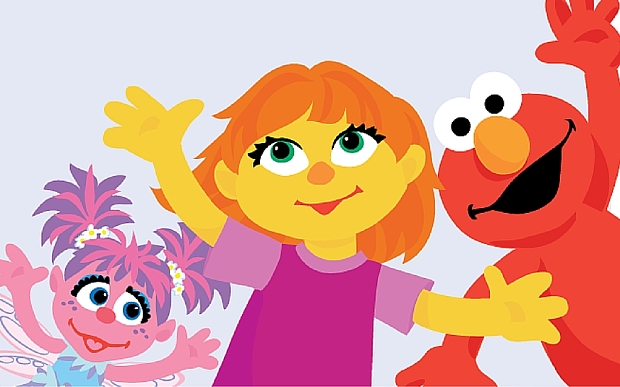
Julia is a new character on the children’s show Photo: Sesame Street
So the Sesame Street#SeeTheAmazing autism program was launched and shared and talked about like mad and of course, torn to shreds and judged and attacked.
Why? Well, I could go into the details but honestly, the details don’t really matter. This has happened with every program and story ever created and will continue to happen.
No one autism story takes every single perspective into account. They just can’t. Many of the perspectives conflict, making it very difficult to include together and there are just so many that it’s nearly impossible to remember to include them all.
Personally, I’m attacked every single time I talk about how great a person with autism can be, because I’m not talking about how disabling autism can be. Then I write about how disabling autism can be and I’m attacked because I’m not making autism sound like the best gift ever.
This happens every single time.
Cure vs acceptance
Parent vs autistic
Person first vs Identity first
Children vs adults
Independent vs dependent
Verbal vs non-verbal
Boys vs girls
Toxins vs genetics
It really doesn’t matter to whom you are talking or whom you’re talking about or what position you take or how much good you do. None of that matters.
You will be hated for it.
Sesame Street’s program isn’t perfect because I didn’t create it. Even if I did, it would only be perfect for me. Not for everyone else. Lots of people would hate it.
That’s the whole point.
This is why we don’t only have one company doing one program or one person telling one story.
Parents will reach other parents. Autistics will reach other autistics. Somewhere in the middle of it all, we’ll all reach each other. But not everyone will like it.
There’s 2 things we should work on in this regard:
1. Don’t attack each other. Constructive criticism is educational. Hateful attacks create closed minds. Show people how your story is different. I’m sure they’d even appreciate that. Just don’t attack them because their story doesn’t align with yours.
2. Don’t take the criticism personally. Some people are not going to like what you say because it’s not what they wanted you to say. So long as you have something to say, there will always be people who will want you to say what they want said. It’s personal for them, it’s not personal against you. They’re allowed to wish you said what they wanted to hear.
If you are doing good work and making a positive impact and changing lives, keep going. Let other people worry about their own programs and their own stories.
There’s more than enough room for everyone and there is more than enough stories.
That’s where real autism understanding and acceptance comes from.
For the second year in a row, I put out a plea to the Minecraft community to help me put a stop to the bullying that happens on Minecraft servers around the world but also bullying that happens anywhere and more specifically, how much more often it happens to those that have autism. For the second year in a row, the Minecraft community answered.
This year several people that make YouTube videos of themselves playing Minecraft made some heartfelt and powerful videos sharing their experiences and opinions, helping to support us in our mission. These people did this because they knew that these videos, as painful or awkward or difficult to make as they may be, will help at least one person somewhere and that makes it worth it.
I put some of those videos at the bottom of this post for you to watch.
On April 2nd, I decided to live stream (play Minecraft in a live video for others to watch and chat with me) in an attempt to get my message out and to explain why I was so passionate about this. My Minecraft server, Autcraft, was built specifically to give children with autism a safe place to play, free from bullying and hate. It’s a place that I wish never had to be made in the first place, and so I spoke out to what few viewers I had.
As hour followed hour, my viewership grew. More people came to watch me. I took a ten minute break for something to eat, fearing to take too long for I might lose those people. But they didn’t leave. The numbers continued to grow, as did the support.
I intended to stream for a few hours at most but more and more people came to watch me… to listen to me! And then, it happened… Arkas appeared in my live stream chat.
Now, I’m going to start mentioning a lot of names in this next part and you are forgiven if you don’t know who they are. They are people that play Minecraft on YouTube and in live streams of their own and have thousands, hundreds of thousands and even millions of people subscribed to watch them. They influence these people. When they speak, their viewers listen.
If you play Minecraft or have a child that plays Minecraft, some of these names may be familiar to you, if not, then just believe when I say that they are “celebrities” in the Minecraft world.
Arkas shared the link to my live stream on Twitter and appeared in my chat room to let me know that he supports me. Shortly after, he was followed by Docm77. He too, shared the link on Twitter. Suddenly I had more viewers than I imagined I ever would have and they were in my chat room, talking with people and me and supporting me.. supporting the autism community that I represented.
Before I knew what was going on, I was adding them both to the server’s whitelist and they were there… on the server… with the children! Talking to them, taking screenshots together, giving those children on the server, autistic children, autistic adults and family, giving them the best day of their lives.
We had a wider audience, we were teaching so many people about bullying, autism and about how amazing people with autism can truly be!
But it didn’t stop there.
To my total amazement, another YouTuber then joined the server. Etho.
You need to understand that for me, Etho is the first that I had watched and quite literally taught me most of what I know about Minecraft and, without ever knowing it, gave me the know how and confidence to ever start a server of my own. But more so than that, he’s just as important to so many of the children on my server.
But what made his appearance truly amazing is that… that just does not happen. Etho is “illusive,” in fact, that’s what many people call him. He just does not “make appearances.” To show up on my server, with dozens and dozens of children that idolize him (some of the grown ups too)… that told me that what we were doing here truly was that special, it truly was that important. That’s when I knew that we were doing something amazing.
But wait, still not done!
Shortly after that, I was messaged by Keralis! Keralis (along with Arkas) are two of the best builders in all of Minecraft, in my opinion. He messaged me and said that he would come on too. Then another message… Xisuma Void! Xisuma Void passed along the message to the rest of the members of a server he helps to manage called HermitCraft and then suddenly I found myself in a chat room talking to a whole bunch of people that I’ve been watching for years! Biffa2001, ZombieCleo, Zuelgin and Sl1pg8r then joined the server too!
Here I was, this guy all by himself, asking the Minecraft community to help me. To help us. To speak up. All I wanted to do was help but somewhere, in the back of my mind, I thought… “what am I doing?” because I really didn’t think anyone would listen. That’s what I’m used to. I have autism myself and to be quite honest, I’m used to people not listening to me too.
But not in the Minecraft community. They listened. No, they didn’t just listen, they shared the message, they got behind it and amplified it. They didn’t just listen, they talked to me about it and helped me to reach so many people that I never would have reached on my own.
They were so very kind to me and to the kids on my server. They changed lives that day. Not just on the server but in their audiences, in my audience… in our communities and more.
This is what the Minecraft community is capable of and it’s amazing. I want to thank all the YouTubers that did this but I also want to thank the rest of the Minecraft community. I have received so many messages from so many people in YouTube comments, Twitch messages, tweets and so much more from people telling me what a great thing I’m doing and how they support me. When they support me, they support the autism community. When they support the autism community, they support these kids that need us so much.
That’s not to be taken lightly. So thank you Minecraft community, on behalf of myself, my server and the autism community.
These videos are from very kind people that have spoken out… the bottom 2 videos are from the live stream in which all of those YouTube celebrities came to visit Autcraft.
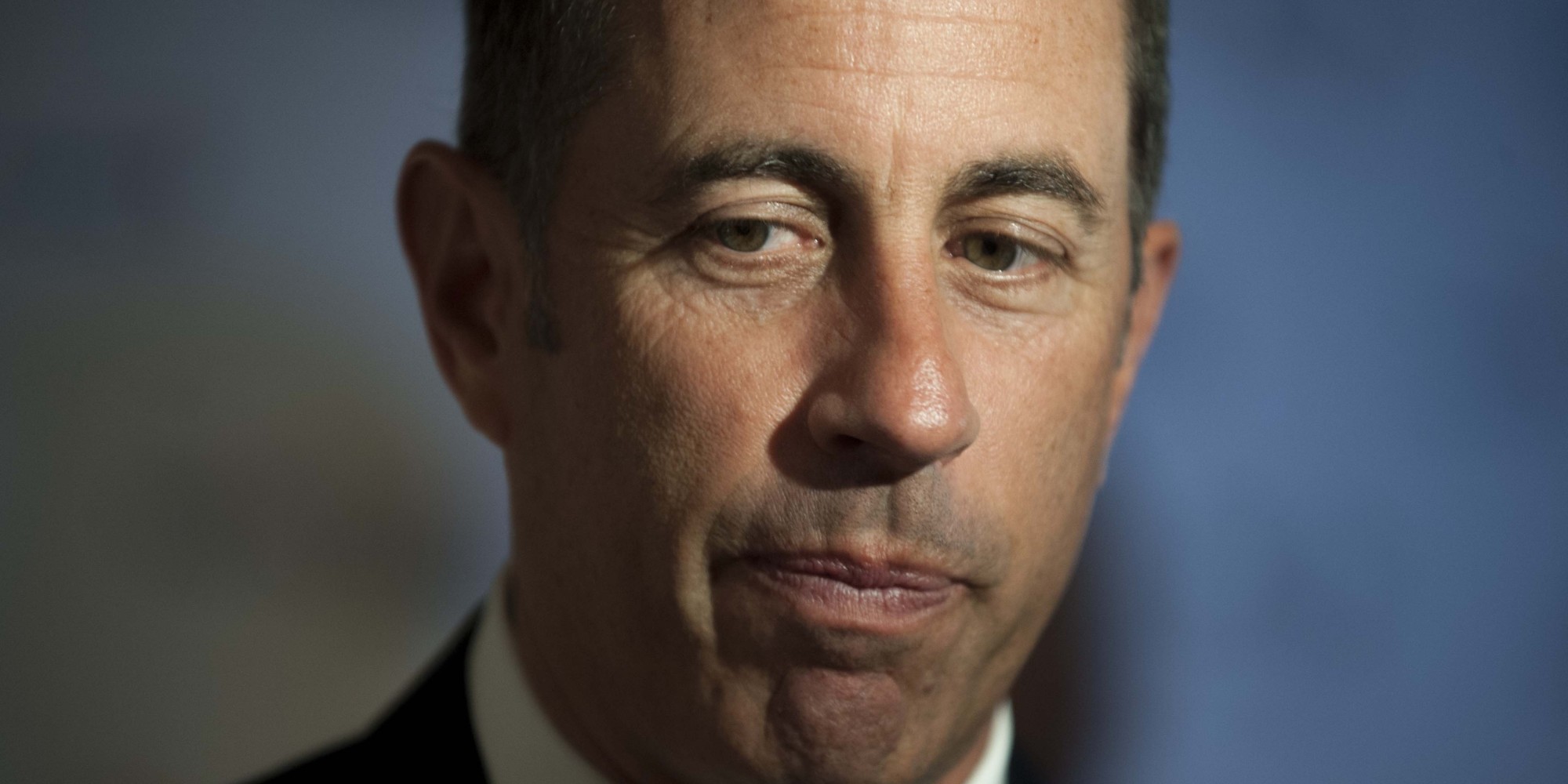
In a statement that made headlines and got mixed reviews amongst the autism community, Jerry Seinfeld revealed during an interview “I think, on a very drawn-out scale, I think I’m on the spectrum.”
I would like to explain why the reviews have been mixed before getting to what I feel is the biggest thing that we should all take away from this but I wouldn’t blame if you wanted to skip straight to it either.
Pros
Many people in the autism community see this as a purely positive thing. Jerry Seinfeld is well loved and regarded as a very successful comedian. In many ways this reinforces their notion that ‘if he can do it, anyone can’ or in other words, there’s still hope for themselves or their children.
Also, a lot of people like to use “you’re so autistic” or some variation as a form of insult but these same people love Seinfeld. So, if a comedian they really like turns out to be autistic himself, is it still the insult that they thought it was?
For most though, it simply is a +1 in the awareness and even acceptance column. Along with others such as Darryl Hannah, Dan Aykroyd, Susan Boyle and others, autism is getting the sort of attention that people only dreamed of as little as 10 years ago. I think most people would agree that to this day, no one really has any clue what autism even is unless it directly affects them such as having an autistic family member or having autism themself.
For a long time, the only time autism seemed to be in the media was when it depicted children hurting themselves or having a meltdown or being institutionalized. This was the public perception, or at least, the way it seemed to be for a lot of people. So the more successful people can come forth and say that they struggled but became successful anyway, the more the public will begin to see that it’s not always something to be ashamed of or afraid of.
Cons
When Jerry Seinfeld made the statement that he felt that it wasn’t a dysfunction but rather a different mind set, many people felt that he outright dismissed and mislead the pubic as to just how much of a dysfunction autism can really be. Even though the news stories aren’t all about children hurting themselves anymore, that is still very much the reality for many people and people like Jerry Seinfeld coming forward after being successful and making people think it’s glorious will not only diminish their struggles but make people forget about them.
Making a self diagnosis like he did takes away from the reality of the whole diagnosis. Children that need constant medication, supervision and support require a lot of funding and awareness but to have public figures just going around and self diagnosing themselves gives everyone the idea that they can do the same. Now anyone that’s a little shy or has trouble making friends will just go diagnosing themselves and spreading all kinds of inaccurate or even outright false information. There are a lot of disorders and disabilities and doctors spend many many years learning about them all to ensure that they don’t make any mistakes and yet they still do so for someone to just up and say they have a disorder is a slap in the face to those doctors and is also a very big leap of faith since in all likelihood, they could be right that they have a disorder but entirely wrong on which disorder they have… or they may have no disorder at all and are just introverted or something.
The Takeaway
The one thing that you really have to take from all of this is that he’s not talking about you. He’s not talking about you, your child, your situation, your experience or anything else to do with you… he’s talking about Jerry Seinfeld and only Jerry Seinfeld.
When he speaks about his mind set, his struggles and how he doesn’t view what he’s gone through as a dysfunction, he describes his experience. He describes what autism is as it relates to Jerry Seinfeld.
In our ever so strong desires to have our own story told, have we gone so far as to deny others their story if it doesn’t represent or even contradicts our own? In turn, shouldn’t our own stories then be denied as well when someone else finds that it doesn’t mesh with their own? How can any of us ever feel safe to share our stories and experiences and raise awareness in our own way if there is always going to be those out there that hate us for not representing them?
Speaking of feeling safe, is it any wonder that people are afraid to get a diagnosis? or speak out about autism? or say anything!?!? Is this really how we treat someone when they come to feel that they themselves are on the spectrum?? Is this what you want for your children?? To be attacked by half of the community that they suddenly find themselves to be a part of only because they are sharing who they are?? To be scared into silence?
For all we know, he could be wrong. He’s not a professional in health nor does it seem that he’s consulted with one, but of all the people that I’ve known to self diagnose themselves, not a single one of them did it because it would be funny or a cool thing to do. They do it after a lot of self reflection, a lot of deep soul searching and a lot of forethought. It’s not an easy thing to come to terms with and an even more difficult thing to share with others.
But isn’t a self diagnosis pretty much how the majority of official diagnoses ever come to be? That is, don’t we need to see the signs in our children or in ourselves in order to seek out an assessment? Yes, there are times when someone suggests it or our doctor catches it but the majority of people I talk to, people make that determination on their own, even if not entirely sure. It’s why we raise awareness! So that people can do that.
If my own son goes on to do well and become famous enough, I’d hate for him to be afraid to mention that he has autism because of how polarizing or hateful people within the autism community can apparently be. For one, I’d like to think that he’d be strong enough to deal with that anyway but more so, I’d hope that the autism community could move beyond things like this and accept that a person can speak of themselves and their experiences without judgement or attacks.
No, Jerry Seinfeld didn’t diminish autism or the public’s perception of it… he shared something personal, about him. That’s totally within his rights to do.
I keep seeing some disturbing responses to the Kelli Stapleton case and I thought I’d address a couple of them today… a sort of, let’s clear the air, type of post.
Without wasting too much time, let’s get right into it.
Copycat Crimes
In a recent statement from ASAN (Autistic Self Advocacy Network), they condemned Dr. Phil’s interviews with Kelli Stapleton stating “We see a pattern of copycat crimes whenever there is a well-publicized case of a parent murdering, or attempting to murder, their disabled child … Dr. Phil had an opportunity to shut down this cycle of violence, and instead he chose to perpetuate it, as loudly and widely as possible.”
I have long seen many people get adamantly upset any time anything to do with autism is portrayed negatively in the media. Whether it’s adults that still behave as children, needing parenting for life or children behaving violently, no matter the situation, if it “makes us look bad”, the media is the bad guy.
I wonder though, where were these people when mothers were murdering their children that didn’t have autism? How come no one screamed about the risk of copycat crimes when these mothers killed their children?
I don’t know if you noticed or not but those stories are from 2014 alone and that’s not nearly all of them. Where’s the outrage? Why is there no one calling for the end of the journalists that reported these stories?
In our efforts to protect children with autism, do we now not care about any child that doesn’t?
There are more of these murders every year than there are months on the calendar but one murder attempt on a child with autism in the last year and suddenly we fear copycat crimes? No, we fear our own public image being damaged, nothing more.
The truth is that media attention is good. Whether your stance is that there should be more services (this will convince people of that) or if your stance is that she’s a monster for trying to kill her child (this will convince people of that too), media attention is not what leads to another tragedy like this, doing nothing is.
We must focus on figuring out how to prevent all of these stories from ever happening again. And crossing our fingers and hoping that no one becomes a copycat is simply not going to do it.
How can anyone sit there, in their big self righteous chair, and claim that a “copycat crime” is our biggest concern? How can anyone honestly sit there and try to tell me that the last mother to attempt to murder their own child did it only because they saw someone else do it on the news and thought “hey, I can do that!”
No, either
A – they are totally out of their minds, in which case, it was just going to happen no matter what or
B – they hit rock bottom and saw no other way out and don’t care in the slightest what any other mother has ever done. They just don’t.
Copycat crimes are not what this is about. It never was.
If you’re really worried about this happening again, let’s talk about real ways to prevent this from ever happening again.
Which leads me to…
Murder is never OK
I keep hearing this and as a statement on it’s own, I agree. However, this statement is a precursor to the rest of the intended message which is “now is not the time to discuss a lack of services or support or funding.”
I have one simple question then, when is the right time? During the lull between the last attempted murder and the next one? Or after the next one? Or the one after that? Do we look around and go “What? Too soon?”
Let me put it another way, if we never get around to discussing how we can lend help to the next parent that is reaching the end of their rope, for what ever reason, are we partially to blame? Well, no, I suppose not since “murder is never OK”, right? We can wash our hands of all blame.
I’ve seen it go even further than that. I’ve witnessed good people be verbally and brutally torn apart for so much as suggesting that they think events could have played out differently if the support had been there. I’ve seen people be accused of the most horrid and vile things simply for suggesting that they have it rough too and understand how someone could reach the point of murder/suicide.
Now, let me be clear, no one ever said they condone it or would ever do it themselves. They only said that they’ve been depressed and felt helpless and felt alone and felt abandoned and they understand what that murderous mother felt. Not that they’d do it too, but that they take the time for understanding… that they have shared a similar experience at least in leading up to the crime.
When a mother (or father) comes to you saying how hard they have it, how difficult their lives are, how no one is there to help, how no one seems to care, how there is no money, how there are no services… and when they say that they understand how hard it must have been for the last mother that was in the news, if you take that as an opportunity to beat that parent down with your words, to bully and chastise, to degrade and humiliate and to dehumanize that parent with all of your might…
What do you do when the parent you bully is the next parent you read about in the news? What do you do when you realize that you pushed them to it?
You do NOT get to throw your hands in the air and say “don’t blame me, murder is never OK.” No, you are not without guilt here. You are in fact a part of the problem. In fact, you’re worse than the lack of support, you’re the opposite of support. And if that mother that you’re beating on is the next one we read about in a headline, I will never ever forgive you. I will never ever let anyone forget what you had done and I will never ever stop reminding you of exactly who is to blame.
You know what? You’re right, murder is never OK. But that doesn’t mean we forsake our humanity and it certainly doesn’t give you a right to forsake yours.
Yes. A parent that tries to kill their child is a monster. And you’re right, murder is never OK. On that, we’ve never disagreed. It’s what comes next that you need to figure out with the rest of us.
Now, either learn to start helping people that need help or get the hell out of the way of the people that will.
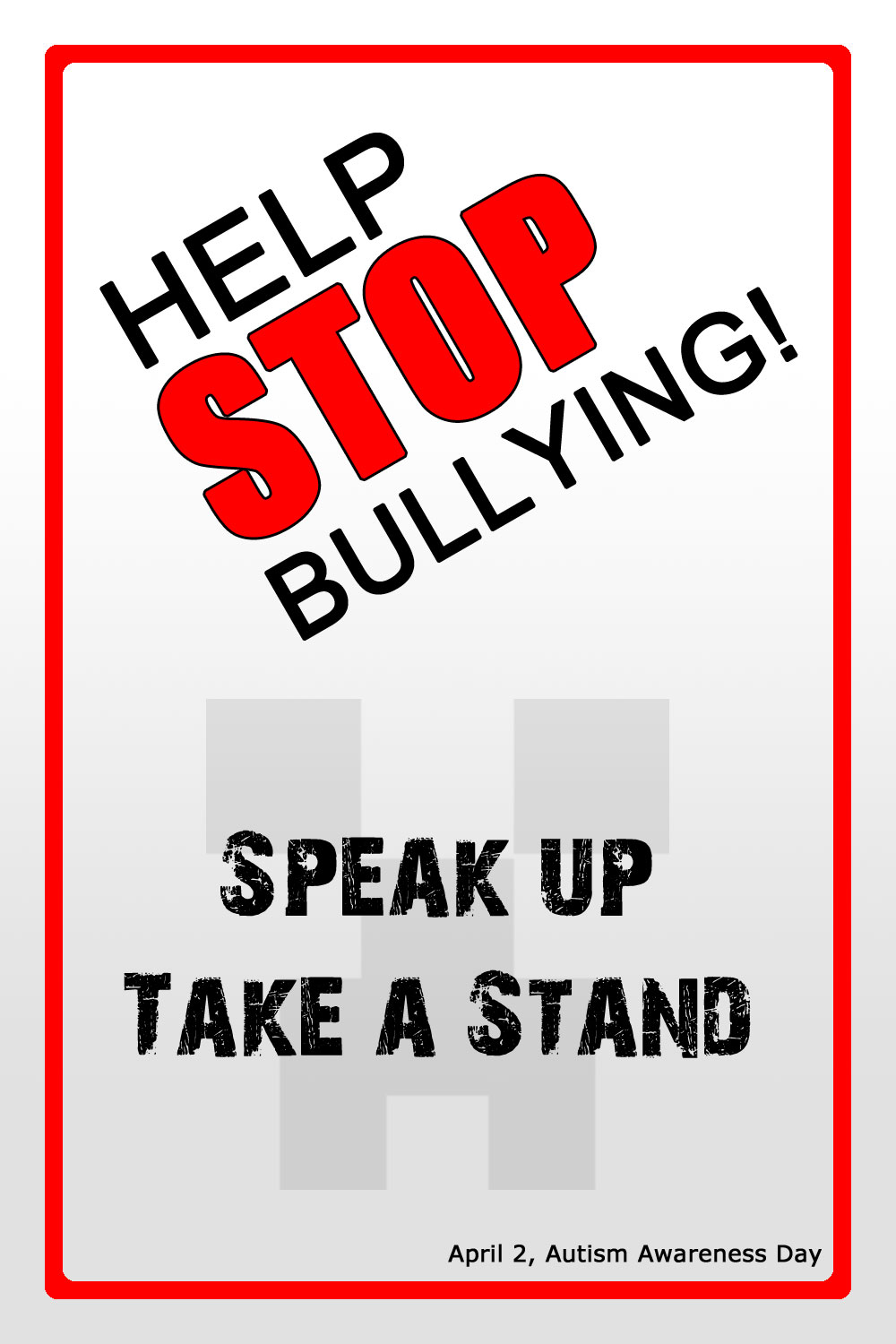
Hi, I’m AutismFather. Well, that’s what I’m known as in Minecraft. I recently created a Minecraft server for children with autism and their families. Due to its crazy success and the incredible amount of stories from those children about how often they’re bullied, not just in real life but on other Minecraft servers, I put out a challenge to the Minecraft community to speak up and take a stand against bullying on April 2nd, Autism Awareness Day.
Most people seem to believe bullying can’t be stopped and that it’s just a regular part of growing up or that it’s so common place now that it’s a normal part of life. So I figured people would think it’s nice that I want to try and stop it but that it’s really quite pointless.
To be honest, I thought that my plea for help would go largely ignored.
I was wrong.
Support
Support on Twitter
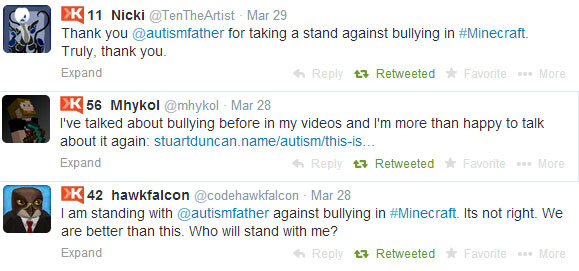
Twitter lit up, sharing my blog post and retweeting it far more than I ever expected and then a couple days later, I discovered that it was shared to reddit. I thought to myself that, knowing reddit, I should just not even click because reading the comments there often upsets me. But I was getting a lot of clicks, so I checked it out. To my surprise, it had received over 1200 “up votes” and 200 comments and almost the entirety of it was in support of what I was doing. People opened up about their own experiences with bullying and people were vowing to pitch in and help out. It was awesome!
One Saturday, March 29th, 14 different live streaming Minecraft players got together and filled over 12 hours of consistent live video to help support my server (Autcraft) by raising money and also awareness of not just the server but autism in general as well as bullying.
The campaign raised $800 in total for the server but more importantly, got people talking. During several live streams, I joined in to discuss what autism is, why autistics are targeted often by bullies and some of the things to be aware of when you see an autistic on a server, especially if you see them being bullied.
This spurred on more conversations both in the chats of those streams and on forums and twitter (that I saw). It was extremely encouraging to see and be a part of.
Some live stream entertainers went the extra mile, setting benchmarks along the way as AudioModdified danced for the entire “What Does the Fox Say?” song, Tewkesape did 20 sit-ups at one milestone and then “twerked” (or tried to) at another and finally, HypeGameboy shaved his head on camera for all to see when we reached $700.
An even bigger thanks to Graphoniac who came up with the idea and organized the whole thing. This was a huge undertaking that I, personally, will never ever forget and just can’t thank her enough for.
And the biggest thanks goes to those that donated, participated and showed your support. If you listened to any of it, you took the time to just find out what I am all about or what I’m doing, I just can’t thank you enough.
What now?
Well, the money from the marathon is already set and ready to go towards new servers. Our server has some very unique challenges in that survival servers were never really meant to be networked together the way minigame servers are. So we have to solve many problems, have all new plugins developed and most of all, get even more servers. Growing to 3800 people on the whitelist in 9 months has not been cheap and so the money raised is just an incredible life saver for me.
We’re going to continue to be there for these children and their families. We’re going to be there for as long and as many that need us.
And for the fight against bullying in the Minecraft community? Well, this blog post continues to build upon that. I’ve written 2 rather dark posts to help show just how bad the problem really is.
This post, I hope, both counters and adds to those posts by proving that the Minecraft community will not sit idly by and let this happen. Whether people think that bullying is normal in schools or on the Internet or anywhere else, clearly the Minecraft community refuses to accept that it should have any presence on our servers.
This is very encouraging to me. I hope it’s encouraging to you as well.
Help Stop Bullying
Please, don’t sit back and hope that others will speak up so that you don’t have to. Record a video, write an article, tweet it, share it, get on a server to talk about it… what ever you need to do whether your audience is 10 or 10,000, please don’t ever think that you’re not important enough to make a very real difference and a very real positive change.
This post should prove to you that bullies can change, people will stand up and support you and that lives can be saved. All you need is a keyboard and the passion to see it through.
By doing this on April 2nd, you won’t just be supporting me. Not anymore. You’ll be joining us. All of us. The Minecraft community and the autism community and everyone that has decided that it’s not ok and that it’s time for the bullying to stop.
I’ve always been proud to be a part of the Minecraft community but now I have a whole other level of respect and admiration for this great group of people. We still have a few days to go until April 2nd and already I am seeing changes being made and lives being affected. That’s a very powerful thing.
Big things are happening and I would love for you to be a part of it.


 I keep seeing some disturbing responses to the Kelli Stapleton case and I thought I’d address a couple of them today… a sort of, let’s clear the air, type of post.